
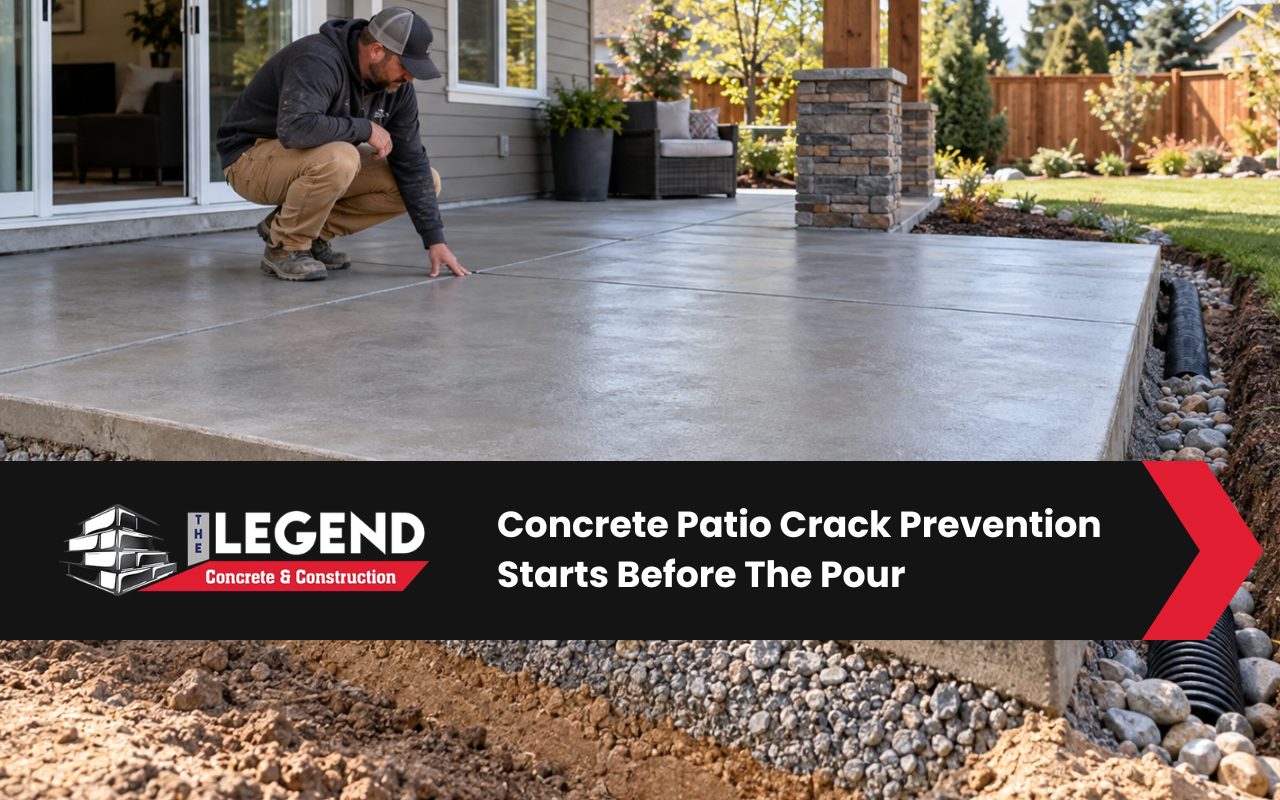
Most concrete patio crack prevention decisions happen before the slab is finished. Base preparation, joint layout, reinforcement, curing, drainage, and weather conditions all influence how a patio handles shrinkage and movement. request your patio estimate when you want a new slab planned around long-term performance.
At The Legend Concrete & Construction, we bring 13+ years of experience to residential and commercial concrete work where prevention begins with preparation.
Base Preparation Helps Reduce Uneven Patio Movement Later
Loose soil, poorly compacted fill, or inconsistent support can allow sections of a patio to move differently. A stable base helps distribute load and gives the slab more uniform support.
Drainage around the patio also matters because saturated soil can weaken support under portions of the slab.
Control Joints Guide Where Normal Shrinkage Can Occur
Concrete shrinks as it cures, so control joints are used to encourage cracking along planned lines instead of random surface locations. Joint spacing and depth should fit slab dimensions and design.
For more detail, review crack control joints.
Curing Mistakes Can Increase Surface And Shrinkage Problems
schedule your patio consultation when you want the curing process planned with the slab installation. Rapid moisture loss, hot conditions, or poor curing practices can increase the risk of surface defects and shrinkage cracking.
Free estimates are available 24 hours for patio planning and repair discussions.
Use This Patio Crack Prevention Checklist Before Installation
- Confirm stable base preparation.
- Plan drainage away from the slab.
- Lay out control joints before finishing.
- Coordinate reinforcement with design needs.
- Protect fresh concrete during curing.
- Avoid premature heavy use.
This checklist keeps attention on the full slab system instead of focusing only on the visible finish.
Patio Edges Need Support To Resist Future Breakdown
Slab edges can be vulnerable when surrounding soil erodes or traffic repeatedly loads unsupported areas. Good grading and backfill help protect the perimeter after construction.
For broader patio planning,review concrete patio services. Our licensed and insured service supports professional installation and repair work.
Surface Finishes Should Match Outdoor Exposure And Use
Broom finishes, decorative textures, and other outdoor finishes should provide the right balance of appearance and traction. Finishing too early or overworking the surface can create durability problems.
For finish ideas,review outdoor concrete finishes.
Repair Decisions Depend On Crack Width And Movement
| Crack Condition | What To Observe | Possible Next Step |
|---|---|---|
| Hairline | Whether it changes | Monitor condition |
| Widening | Movement over time | Professional evaluation |
| Uneven edges | Vertical displacement | Check support |
| Multiple cracks | Pattern and settlement | Review broader slab condition |
Crack repair works best when the reason for cracking is understood first.
- Plan joints before the pour. Waiting until finishing is underway can make joint layout less consistent with slab geometry.
- Avoid adding excess water at the surface. Overworking wet concrete can weaken the top layer and contribute to future defects.
- Protect fresh concrete from rapid drying. Wind, heat, and direct sun can increase moisture loss during early curing.
- Keep runoff away from slab edges. Erosion beside the patio can reduce support and create settlement at the perimeter.
- Delay heavy furniture placement. Early loading should follow the project’s curing and strength-development plan.
| Prevention Stage | Main Decision | Risk If Ignored |
|---|---|---|
| Before pour | Base and drainage | Uneven support |
| During layout | Joint location | Random cracking |
| During finish | Surface handling | Weak top layer |
| After placement | Curing protection | Rapid moisture loss |
Our team at The Legend Concrete & Construction can help coordinate these steps so patio installation decisions support durability instead of relying on repairs after cracks appear.
- Keep slab geometry simple where possible because sharp reentrant corners can concentrate stress and encourage cracking.
- Plan control joints around columns, steps, corners, and changes in slab width instead of using only equal spacing.
- Protect fresh concrete from foot traffic, furniture, and construction materials during early curing.
- Coordinate patio drainage with adjacent landscaping so runoff does not erode soil beneath slab edges.
- Check whether downspouts empty near the patio and redirect concentrated water when needed.
- Use reinforcement as part of the slab design, not as a substitute for joints, curing, or base preparation.
- Choose an outdoor finish that provides traction without requiring excessive surface manipulation during placement.
- Document any early hairline cracks so future changes can be compared accurately instead of judged from memory.
- Keep patio furniture layout in mind when placing joints so the finished pattern works with how the space will be used.
- Check nearby tree roots and irrigation lines before excavation because hidden site conditions can affect base preparation.
- Plan slab elevation carefully where the patio meets doors, steps, or existing concrete to reduce awkward transitions.
- Protect control joints from debris buildup so normal movement remains visible and maintenance stays easier.
Frequently Asked Questions
Can all concrete patio cracks be prevented?
No. Concrete naturally shrinks and moves, but good design, joints, curing, drainage, and support can reduce unnecessary cracking.
How far apart should control joints be?
Spacing depends on slab thickness, dimensions, reinforcement, and design, so joint layout should be planned for the specific patio.
Does curing really affect cracking?
Yes. Proper curing helps control moisture loss and supports more consistent strength development.
Should small cracks be repaired immediately?
Not always. Monitor whether the crack changes, allows water entry, or creates movement before deciding on repair.
Can sealing prevent structural cracks?
No. Sealing can reduce moisture exposure, but it cannot stop structural movement or replace proper slab construction.
Build Patio Crack Control Into Every Installation Step
Effective patio crack control combines base preparation, joint planning, curing, drainage, and correct finishing before the slab is put into service. book your patio estimate with The Legend Concrete & Construction when you need concrete patio service in Dothan, AL.