
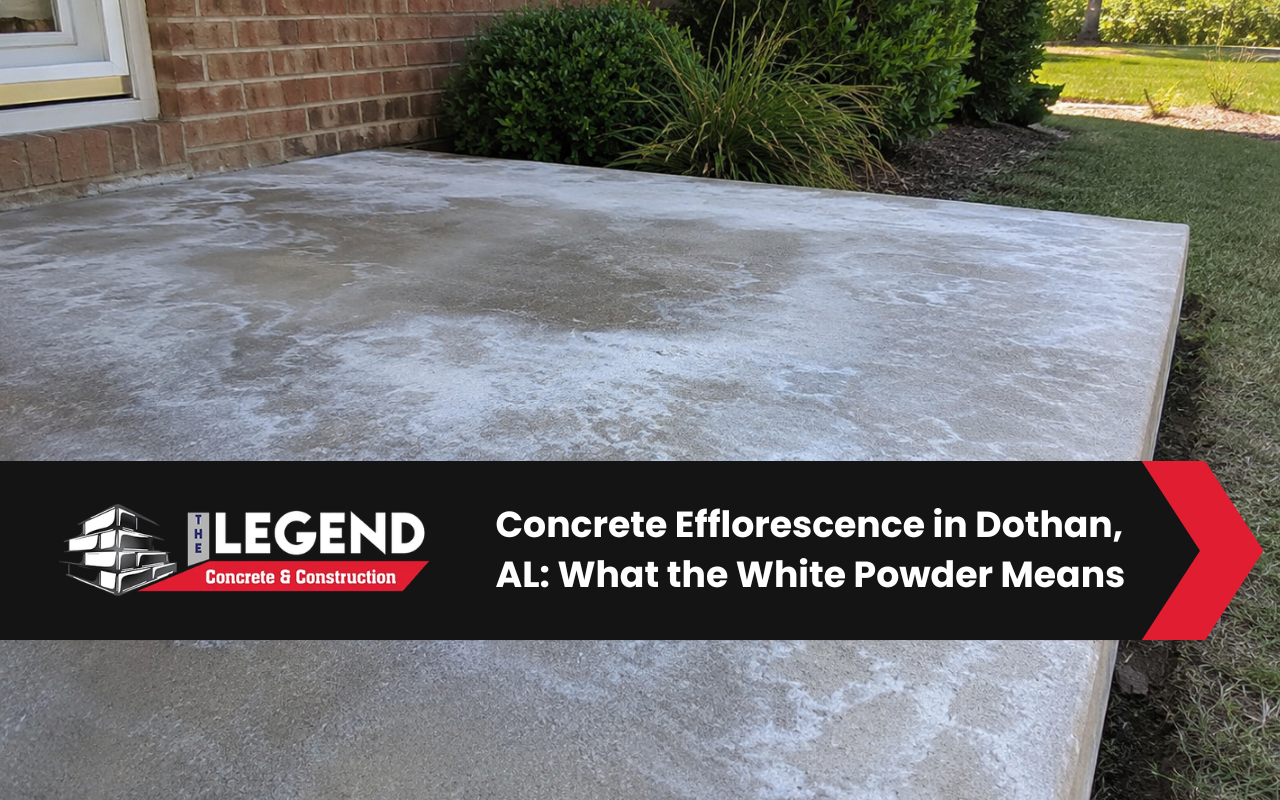
You wash the concrete, let it dry, and a pale white film appears again. That chalky material may be concrete efflorescence, a mineral deposit created when moisture moves through concrete or masonry and leaves salts behind at the surface.
It is often more of an appearance issue than a structural emergency, but repeated deposits can be a useful clue that moisture is moving through the slab. If you are dealing with stains or discoloration, our concrete stain removal guide explains why the correct cleaning method depends on the source.
How Efflorescence Forms
Concrete naturally contains soluble salts. Water enters the slab or moves through pores, carries those salts toward the surface, and then evaporates. After the water disappears, a white or gray powdery deposit can remain.
In Dothan, regular rainfall and high humidity can keep outdoor concrete exposed to moisture. Poor drainage, irrigation, groundwater, and water trapped beneath a slab can make the condition more noticeable.
What White Deposits Can Tell You
| Appearance | Possible Cause | First Action |
|---|---|---|
| Dry white powder | Efflorescence | Brush and monitor |
| Hard crusty deposit | Mineral buildup | Use appropriate concrete cleaner |
| Cloudy sealer | Moisture trapped under coating | Evaluate sealer and moisture |
| White scaling with rough surface | Surface deterioration | Inspect concrete condition |
| Recurring damp white area | Ongoing moisture movement | Find drainage or moisture source |
Where the Moisture Comes From
Rain and Surface Runoff
Water may enter through an exposed slab, joints, cracks, or edges. Low spots that stay wet can contribute to recurring deposits.
Moisture Beneath the Slab
Ground moisture can migrate upward through concrete. New enclosed slabs are often designed with vapor-control measures where required by the project and code.
Our article on vapor barriers for Alabama slabs explains why moisture control below concrete matters in many applications.
Irrigation and Landscaping
Sprinklers that repeatedly wet a wall, patio edge, or slab can create a constant moisture source. Soil piled too high against concrete can also keep the surface damp.
How to Clean Mineral Deposits Safely
Fresh, light efflorescence may sometimes be removed with a stiff dry brush. More persistent deposits can require water and a cleaner intended for concrete.
Avoid immediately reaching for the strongest acid or pressure setting. Aggressive cleaning can etch the surface, change decorative color, damage surrounding materials, or leave a noticeably different patch.
Expert Tip: Test any cleaner on a small, hidden section first. Decorative or sealed concrete can react differently from plain unfinished concrete.
For general maintenance, see our guide to cleaning concrete driveways safely.
When Efflorescence Keeps Coming Back
If white powder returns shortly after cleaning, the bigger issue is moisture. Ask where water is coming from and where it is supposed to go.
- Does rain collect against the slab?
- Are downspouts emptying nearby?
- Is irrigation soaking the same area?
- Are cracks allowing water into the concrete?
- Does the slab sit lower than surrounding soil?
- Is a coating trapping moisture?
Fixing the water source can be more important than repeatedly cleaning the visible deposit.
Does Efflorescence Mean the Concrete Is Failing?
Not necessarily. Efflorescence can occur on otherwise sound concrete. However, if the white deposits appear with scaling, deep cracks, settlement, crumbling edges, or constant water entry, the slab should be inspected for broader damage.
At The Legend Concrete & Construction, we evaluate both the surface and the surrounding drainage before recommending repair.
Permits and Concrete Surface Repair in Dothan
Basic cleaning and minor surface maintenance may not involve the same permit requirements as new structural work. Larger alterations, slab replacement, additions, or commercial improvements can require city approval.
Dothan requires permits for new construction, alterations, and additions, although some minor nonstructural repairs may be handled differently. When a project changes drainage or site conditions, local stormwater requirements may also matter.
Protecting Concrete After Cleaning
After the surface is clean and dry, a compatible sealer may reduce future staining in some situations. But sealing a slab with unresolved moisture movement can trap water and create a different appearance problem.
That is why inspection should come before coating.
Concrete Efflorescence FAQs
Is concrete efflorescence dangerous?
Efflorescence itself is usually a mineral deposit rather than a structural failure. Repeated deposits can still indicate ongoing moisture movement that deserves attention.
Can I pressure wash efflorescence off concrete?
Pressure washing may remove some deposits, but excessive pressure can damage the surface. Start with the least aggressive cleaning method that works.
Why does white powder return after cleaning?
New moisture may continue moving salts to the surface. Drainage, irrigation, cracks, ground moisture, or a coating problem may be contributing.
Can a sealer stop efflorescence?
A sealer may reduce water entry from above in some cases, but it should not be used to hide unresolved moisture moving from beneath the slab.
Do you repair concrete with surface damage in Dothan?
Yes. At The Legend Concrete & Construction, we inspect residential and commercial concrete and can recommend cleaning, surface repair, resurfacing, or replacement when appropriate.
Get a Clear Answer Before Repeated Cleaning
At The Legend Concrete & Construction, we provide residential and commercial concrete service backed by more than 13 years of experience. We are licensed and insured, offer free estimates, and maintain regular hours Monday through Saturday from 6:00 a.m. to 8:00 p.m. Our 24-hour availability is there when an urgent construction problem cannot wait.
Request a free concrete surface evaluation and find out whether the white deposits need cleaning, moisture correction, repair, or a combination of services.