
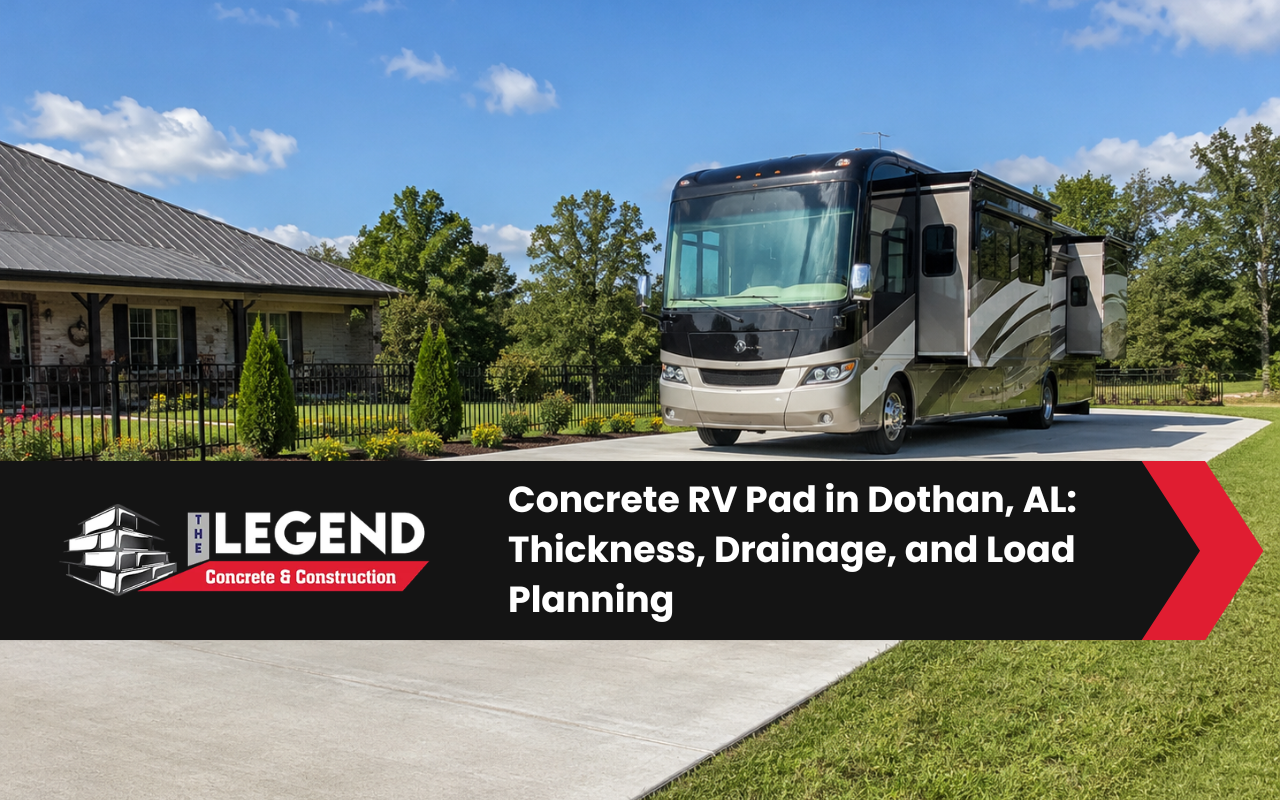
An RV weighs far more than a typical passenger vehicle, so parking one on a thin or poorly prepared slab can lead to cracking, settlement, and drainage trouble. A well-built concrete RV pad needs the right base, thickness, reinforcement plan, slope, and access for the size and weight of the vehicle.
Before planning a new pad, it helps to review the broader concrete and construction services available for driveways, pads, site work, and related improvements. At The Legend Concrete & Construction, we work with both residential and commercial customers and bring more than 13 years of experience to concrete projects in the Dothan area.
Start With the RV, Not the Concrete
The vehicle should guide the slab design. A small travel trailer has different needs than a large Class A motorhome, fifth-wheel, work truck, or commercial vehicle.
- RV length and width
- Approximate loaded weight
- Number and position of axles
- Whether leveling jacks will be used
- How often the vehicle moves
- Whether the pad connects to a driveway
- Planned electrical, water, or sewer access
How Thick Should an RV Pad Be?
There is no universal RV pad thickness that fits every vehicle or soil condition. Thickness should be selected based on expected loads, base preparation, reinforcement, soil support, and local requirements.
| Use | Design Concern | Planning Priority |
|---|---|---|
| Travel trailer | Concentrated wheel and jack loads | Firm base and adequate slab thickness |
| Fifth-wheel RV | Higher axle loads | Reinforcement and stable subgrade |
| Large motorhome | Heavy total vehicle weight | Load-based slab design |
| Commercial vehicle | Repeated heavy traffic | Stronger base and edge support |
| RV plus tow vehicle | Longer traffic path | Entry geometry and drainage |
Why Base Preparation Matters So Much
Heavy vehicles place concentrated pressure on concrete. If the soil beneath the slab is soft, wet, poorly compacted, or full of organic material, the slab may move even when the concrete itself is strong.
Proper preparation may include removing weak soil, grading the area, placing a compacted aggregate base, and correcting drainage before the pour. Edge support is especially important where RV tires enter or leave the pad.
Our article on driveway edge reinforcement methods explains why unsupported edges can become a weak point for vehicle traffic.
Drainage Around RV Pads
Dothan gets frequent rain, so a flat pad with nowhere for water to go can become a long-term problem. Standing water may soften nearby soil, stain the slab, create muddy access areas, and contribute to settlement near the edges.
Good Drainage Planning Includes
- A controlled slope away from buildings
- No low spots beneath the RV
- Safe runoff direction
- Protection for neighboring property
- Stable shoulders beside the pad
- Coordination with existing driveway drainage
Dothan actively manages stormwater infrastructure, so larger site changes should account for runoff and drainage requirements. Commercial projects may require additional site planning or review.
Reinforcement and Heavy Vehicle Loads
Reinforcement can help control cracking and improve slab performance, but it does not replace proper thickness or base preparation. Depending on the project, reinforcement may include rebar, welded wire reinforcement, fiber reinforcement, or a combination.
Common Mistake: Do not assume that adding more rebar will fix a soft subgrade. If the ground moves, the concrete above it can still crack or settle.
Permits and Site Planning in Dothan
New construction, additions, or site improvements within Dothan may require permits depending on the scope. A pad that affects access, drainage, utilities, setbacks, or commercial use may involve additional requirements.
Before work begins, confirm whether your project needs city approval. Utility locations should also be checked before excavation or grading.
For local project planning, see our construction services in Dothan.
Residential vs Commercial RV and Vehicle Pads
Residential pads often focus on convenient storage, driveway access, and keeping the RV off soil or gravel. Commercial pads may need to handle repeated traffic, delivery vehicles, trailers, or heavier equipment.
At The Legend Concrete & Construction, we plan each project around actual use rather than treating every slab the same.
What Should Be Included in an RV Pad Quote?
A useful concrete RV pad quote should clearly address site preparation, dimensions, thickness, concrete placement, reinforcement, finish, joints, drainage, cleanup, and any expected site limitations.
We provide free estimates and licensed and insured service. Our regular hours are Monday through Saturday from 6:00 a.m. to 8:00 p.m., and 24-hour availability is also offered for urgent service needs.
Request a free concrete RV pad quote for your Dothan property and get a slab designed around how you actually use your vehicle.
Frequently Asked Questions 
How thick should a concrete RV pad be?
The correct thickness depends on RV weight, soil support, reinforcement, base preparation, and expected use. A contractor should evaluate the site and vehicle before choosing a design.
Does an RV pad need reinforcement?
Many heavy-vehicle slabs benefit from reinforcement. The type and amount depend on slab dimensions, loads, base conditions, joints, and project requirements.
Should the pad slope or stay completely level?
The parking surface should feel stable, but it still needs planned drainage. Slight controlled slope can move rainwater away without creating a noticeable parking problem.
Can an RV pad connect to my existing driveway?
Yes. The transition should be designed to reduce abrupt height changes, weak edges, and drainage problems where the new slab meets the existing driveway.
Do you install concrete pads for commercial vehicles?
Yes. At The Legend Concrete & Construction, we serve residential and commercial customers and can plan pads for RVs, work vehicles, trailers, and other heavy-use needs.