
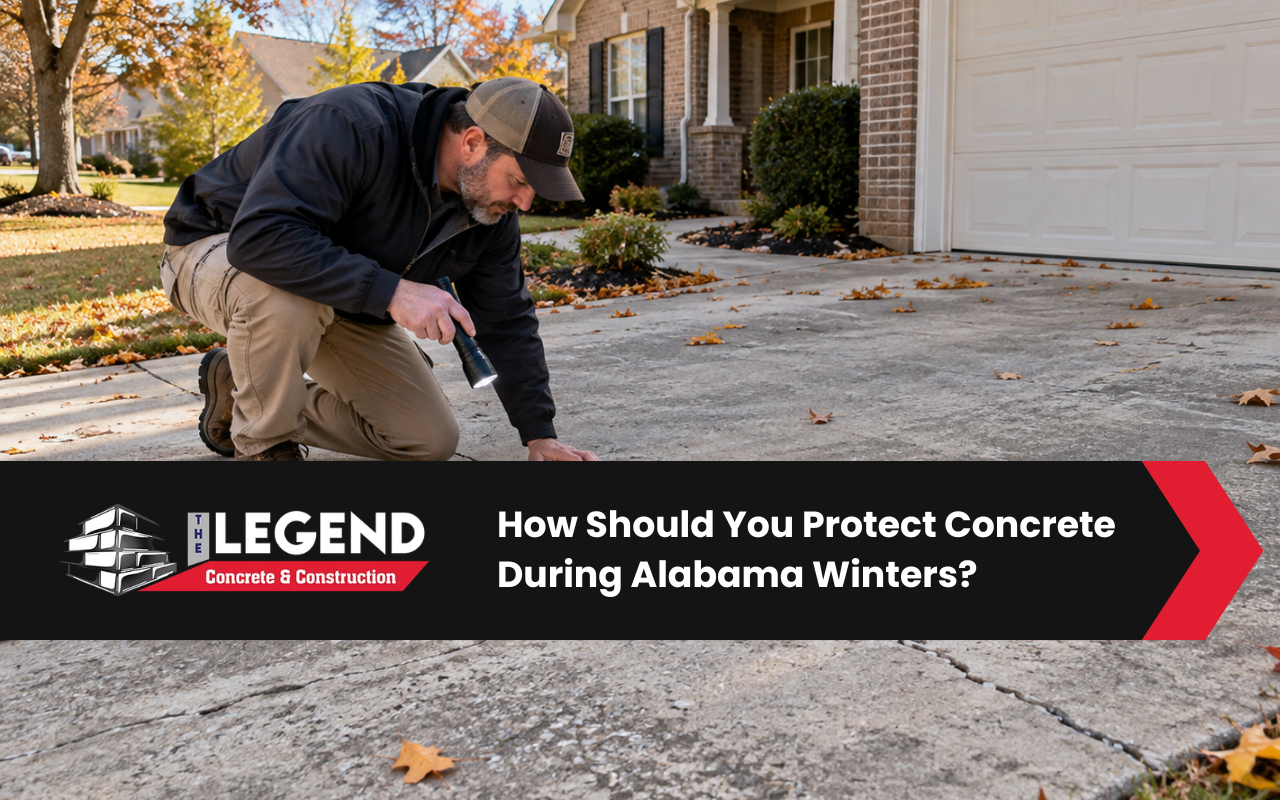
Protecting concrete during an Alabama winter starts with controlling moisture, sealing suitable cracks, maintaining drainage, and avoiding harsh surface treatments. New concrete also needs proper temperature planning, curing protection, and a stable base before placement.
Effective winter concrete care Alabama begins before the first cold snap. Start by reviewing professional driveway sealing options for exposed surfaces.
At The Legend Concrete & Construction, we evaluate existing concrete differently from new winter concrete work. Established driveways and patios need preventive maintenance, while fresh concrete requires careful planning, temperature control, curing, and protection while it develops early strength.
South Alabama Winter Risks for Existing Concrete
South Alabama rarely experiences prolonged severe freezes. However, brief cold snaps can still affect concrete with open cracks, poor drainage, weak surfaces, or existing deterioration.
Concrete is porous. Rainwater can enter cracks and surface openings before temperatures fall. When that water freezes, expansion can place pressure on the surrounding material. Repeated wetting and temperature changes may gradually enlarge existing damage.
Driveways, patios, steps, and walkways also experience different loads. Vehicle traffic, drainage patterns, tree roots, and settlement can worsen problems that become more visible during winter.
Use This Pre-Winter Concrete Inspection Checklist
Begin with a visual inspection while the concrete is clean and dry. Walk each surface slowly and note changes since the previous season.
Driveway and Patio Warning Signs
- Cracks: Look for widening, branching, or new openings.
- Joints: Check for missing or damaged joint material.
- Edges: Identify chips, breaks, and unsupported sections.
- Drainage: Locate areas where rainwater remains after storms.
- Surface wear: Note scaling, flaking, or exposed aggregate.
- Movement: Watch for sinking or raised concrete panels.
Photograph questionable areas and monitor them after major weather changes. Visible movement, recurring standing water, or rapidly expanding cracks may require professional evaluation rather than a temporary patch.
Address Cracks and Joints Before Cold Weather
Open cracks allow water and debris to enter concrete more easily. Cleaning and addressing suitable cracks before winter can reduce moisture intrusion. However, the repair method should match the crack type and underlying cause.
Control joints are intentional features that help manage where shrinkage cracks form. They should not be treated like accidental damage or filled without considering their function.
Before choosing a repair product, learn how joints prevent cracks. A recurring or displaced crack may indicate settlement, drainage, or base problems that surface filler cannot correct.
Keep Driveways Clean and Drainage Paths Open
Leaves, soil, and debris can trap moisture against concrete. Keep surfaces and nearby drains clear so rainwater can move away instead of collecting in low areas.
Avoid allowing downspouts to discharge directly onto driveways or walkways. Concentrated runoff can enter cracks, erode supporting soil, and create slippery areas during sudden freezes.
Regular cleaning also makes deterioration easier to see. For a broader maintenance routine, follow our driveway checklist throughout the year.
Use Safer Traction Methods During Cold Snaps
Deicing products should not automatically be considered harmless because they carry a “concrete-safe” label. Product chemistry, concrete age, surface condition, reinforcement, and application frequency can affect performance.
Sand can improve traction without melting ice. When a deicer is necessary, follow the product and concrete manufacturer’s guidance. Use only the required amount and remove residue after conditions improve.
Plan New Concrete Work Around Cold Weather Conditions
Concrete can be placed during winter, but placement should not depend only on the daytime high. Contractors must consider the subgrade, concrete temperature, overnight forecast, wind, section thickness, mixture, and available protection.
The American Concrete Institute treats conditions as cold-weather concreting when temperatures fall, or are expected to fall, below 40°F during the protection period. Its cold-weather concrete guidance emphasizes preventing early freezing and maintaining strength development.
Scheduling every winter placement early in the morning is not automatically beneficial. A later placement may sometimes offer warmer conditions, while another forecast may require postponement entirely. The complete curing and protection plan should guide timing.
Prepare the Subgrade Before Winter Concrete Placement
Fresh concrete should not be placed on frozen ground, snow, ice, or unstable saturated soil. These conditions can create uneven support and increase the risk of later settlement or cracking.
Cold-Weather Placement Preparation
- Remove ice, standing water, and loose debris.
- Confirm the base is stable and properly compacted.
- Keep contact surfaces above freezing when required.
- Prepare blankets or enclosures before placement begins.
- Review the overnight forecast and protection period.
Adding extra water at the jobsite is not a substitute for cold-weather planning. Excess water can delay setting, affect finishing, and change the intended concrete mixture.
Use Curing Blankets and Temperature Protection Correctly
Insulated blankets help retain the heat produced as cement and water react. Edges and corners often lose heat faster, so they may need additional protection.
Blankets should remain secured and should not be removed abruptly when a large temperature difference exists. Rapid cooling can create thermal stress in young concrete.
Accelerating admixtures may support earlier strength development, but they do not prevent freezing. According to the National Ready Mixed Concrete Association, fresh concrete still requires proper curing and cold-weather protection.
Use This Winter Concrete Placement Risk Guide
| Site Condition | Primary Concern | Recommended Response |
|---|---|---|
| Frozen subgrade | Settlement after the ground thaws | Thaw and prepare correctly or postpone placement |
| Ice or standing water | Poor support and placement problems | Remove moisture and verify the base condition |
| Freeze expected without protection | Early-age strength and durability loss | Arrange adequate protection or reschedule |
| No temperature monitoring plan | Unknown curing conditions | Establish monitoring before placement |
| Sudden severe weather change | Inadequate finishing and curing time | Reevaluate the pour with the contractor |
Frequently Asked Questions
Can you do concrete work during an Alabama winter?
Yes. Winter concrete work is possible when the mixture, subgrade, placement temperature, curing method, forecast, and freeze protection are properly planned.
When should you avoid pouring new concrete?
Avoid placement on frozen or unstable ground. Work should also be postponed when the crew cannot maintain suitable temperatures or protect fresh concrete.
What temperature can seriously damage fresh concrete?
There is no single temperature that destroys every slab. However, NRMCA notes that fresh concrete can freeze near 25°F and lose significant potential strength.
Should an Alabama driveway be sealed before winter?
Sealing may help suitable concrete limit moisture intrusion and staining. The surface condition, concrete age, previous coatings, and selected product should be evaluated first.
Are curing blankets always enough during cold weather?
Not always. Wind, section thickness, temperature, mixture, and forecast may require additional insulation, enclosures, heat, monitoring, or postponed placement.
Protect Your Concrete Before Colder Weather Arrives
Reliable winter concrete care Alabama combines inspection, drainage, appropriate crack maintenance, careful deicer use, and a professional plan for new placements. These steps protect existing surfaces while reducing avoidable cold-weather construction risks.
At The Legend Concrete & Construction, we provide expert concrete care based on the surface condition and project requirements. Our team can evaluate driveways, patios, walkways, repairs, sealing needs, and planned winter concrete work.